Otto Neumann · 10 October 2026
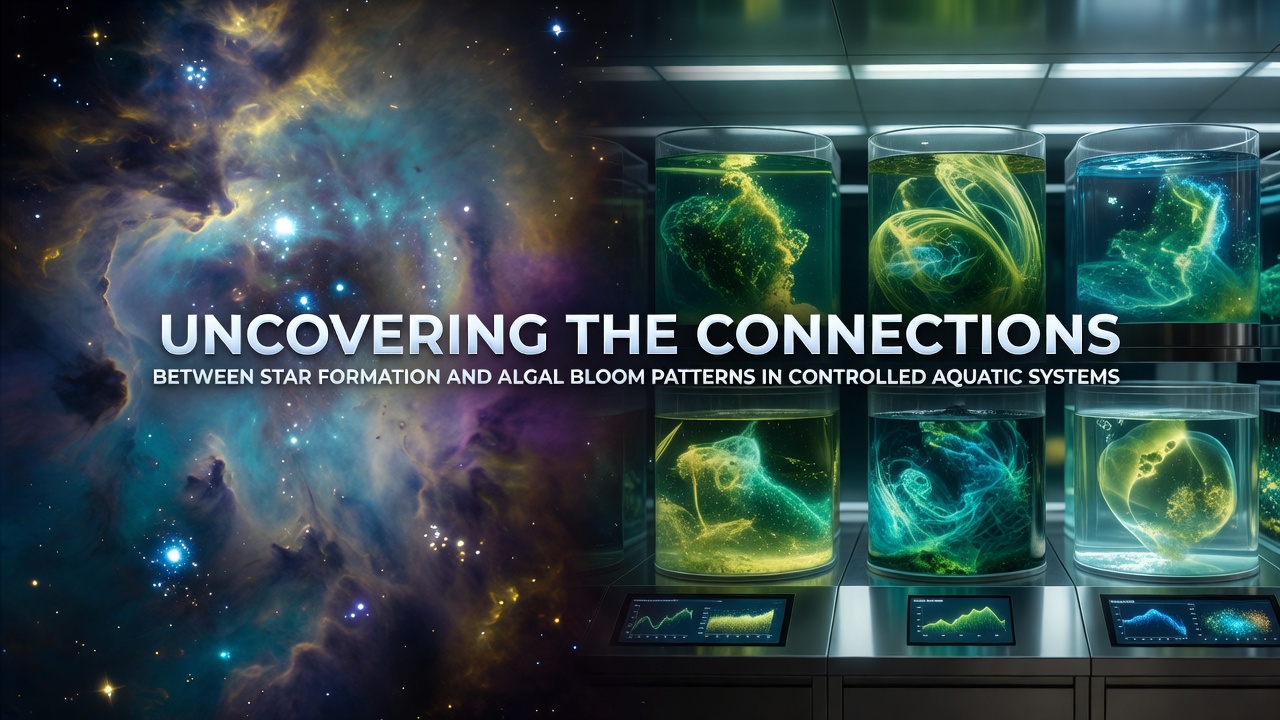
Uncovering the Connections Between Star Formation and Algal Bloom Patterns in Controlled Aquatic Systems
Star formation occurs when dense regions within molecular clouds undergo gravitational collapse, leading to the birth of new stars over millions of years, while algal bloom patterns emerge in aquatic environments through rapid population growth of phytoplankton triggered by nutrient availability and light conditions. Researchers have begun exploring mathematical parallels between these processes in controlled aquatic systems, where laboratory setups replicate density-dependent dynamics and feedback loops observed in both astrophysical and biological contexts.
Pattern Formation in Astrophysical and Aquatic Models
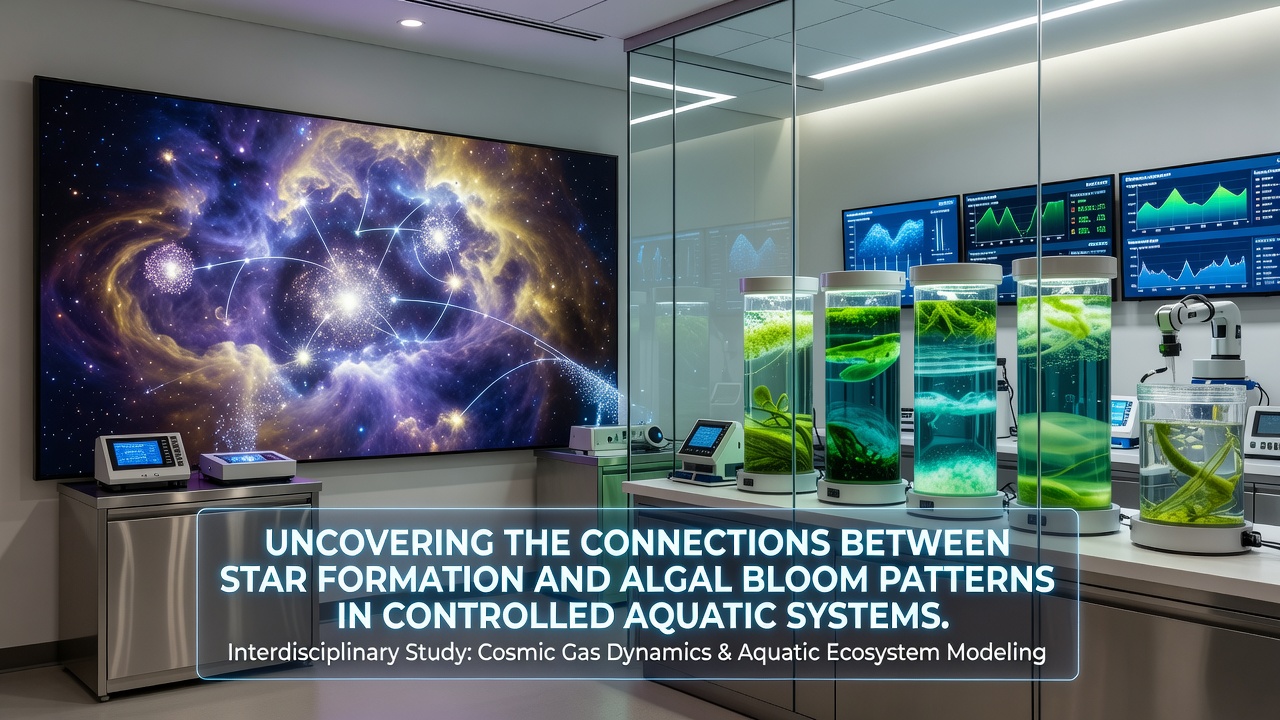
Studies of star-forming regions rely on observations from telescopes that track gas cloud fragmentation and accretion disks, and similar modeling techniques apply to algal systems housed in sealed bioreactors where variables such as nutrient concentration, temperature gradients, and fluid flow can be precisely regulated. Data from these experiments reveal how localized instabilities in one domain mirror density waves that propagate through the other, allowing scientists to test scaling laws that connect gravitational instabilities to population explosions in microbial communities.
Controlled aquatic systems provide repeatable conditions for measuring bloom onset, peak intensity, and collapse phases, and these phases correspond in timing and spatial distribution to stages documented in simulations of protostellar cores. Observers note that both phenomena exhibit self-similar structures when analyzed through power-law distributions, with researchers applying the same computational frameworks originally developed for cosmic hydrodynamics to predict algal distribution across experimental tanks.
Laboratory Techniques and Data Collection
Teams at institutions across North America and Europe maintain mesocosm tanks equipped with sensors that log chlorophyll levels, dissolved oxygen, and hydrodynamic turbulence at high temporal resolution, generating datasets that feed directly into numerical codes used for stellar evolution modeling. In October 2026, several collaborative projects are scheduled to release findings from synchronized experiments that compare bloom trajectories under varying light regimes against outputs from three-dimensional simulations of collapsing molecular clouds.
Evidence from these setups shows that threshold behaviors, such as the critical density required for star birth, find analogs in the nutrient thresholds that initiate exponential algal growth, and researchers adjust parameters in real time to observe how small perturbations cascade into large-scale pattern shifts. Figures released by Environment and Climate Change Canada indicate that controlled studies have quantified bloom durations ranging from days to weeks under fixed conditions, providing calibration points for models that also simulate star cluster formation timescales.
Interdisciplinary Modeling Approaches
Mathematicians and ecologists have adapted equations describing Jeans instability in astrophysics to describe the onset of algal aggregation, replacing gravitational constants with terms for chemotactic responses and nutrient diffusion rates. This cross-application allows predictive mapping of bloom fronts that aligns closely with observed fronts in both field samples and laboratory replicates, and the same codes run on supercomputers originally tasked with galaxy formation now process high-resolution imagery from aquatic experiments.
Academic sources including reports from the Australian Institute of Marine Science document how light attenuation patterns within dense algal layers resemble radiative transfer processes in dusty star-forming regions, enabling direct comparison of opacity effects across scales. Those who have integrated these datasets find that feedback mechanisms, such as self-shading in blooms or radiation pressure in stellar nurseries, produce comparable stabilization or dispersal outcomes when parameters are normalized appropriately.
Current Research Directions and October 2026 Outlook
Upcoming work focuses on multi-phase fluid interactions within aquatic tanks that replicate the multiphase media found in interstellar clouds, with particular attention to how turbulence influences both the fragmentation of gas into stars and the patchiness of algal distributions. Government agencies in the European Union have funded pilot programs that supply open datasets from these experiments, allowing broader analysis of common scaling relations without requiring physical access to specialized facilities.
Researchers continue to refine sensor arrays and imaging protocols so that measurements from controlled systems yield consistent inputs for both ecological forecasts and astrophysical simulations, and preliminary results suggest improved accuracy in predicting bloom termination events that parallel the dispersal of young stellar clusters.
Conclusion
The examination of star formation alongside algal bloom patterns in controlled aquatic systems has produced shared analytical tools and datasets that bridge astrophysics with aquatic ecology. Ongoing projects scheduled through late 2026 continue to test these connections through standardized experimental designs and computational comparisons, yielding quantitative insights into pattern emergence across vastly different physical regimes.